Secure Internet Merchant Account UK in 2026 - Costs & Requirements
Learn how an Internet Merchant Account in the UK works, including costs, requirements, providers, application steps and ecommerce payment processing.

If your business wants to accept credit or debit card payments online, you may come across the term Internet Merchant Account UK when comparing payment providers.
An internet merchant account, often shortened to IMA, is designed specifically for businesses accepting card-not-present payments through a website, ecommerce store or other online channel.
But do you actually need one? How much does an Internet Merchant Account cost? And how is it different from a payment gateway?
This guide explains how a UK internet merchant account works, what businesses normally need to qualify, the potential costs involved and what to consider when comparing merchant account providers UK businesses can use.
What Is an Internet Merchant Account?
An internet merchant account is a type of merchant account designed to enable a business to accept card payments online.
It is different from your normal business bank account.
When a customer makes an online card purchase, the transaction is authorised through the payments infrastructure.
Once the payment has been successfully processed and settled, the funds are ultimately transferred to the merchant's nominated business bank account, subject to the provider's settlement terms.
UK government-backed business guidance describes an IMA as an account that allows a business to accept customers' credit and debit card payments directly online. It also notes that internet transactions are treated differently from face-to-face payments because the card and cardholder are not physically present.
For ecommerce businesses, the payment setup will commonly involve:
Customer → Website → Payment Gateway → Acquirer / Processor → Card Network → Issuing Bank
The internet merchant account sits within this wider payment infrastructure.
How Do Internet Merchant Accounts Work in the UK?
When a customer enters their card information at checkout, several systems work together in a matter of seconds.
First, the customer's payment details are securely captured by the payment gateway.
The transaction is then sent to the processor or acquiring bank. From there, it travels through a card network such as Visa or Mastercard to the customer's issuing bank.
The issuer checks the card, available funds and risk information before returning an approval or decline.
If approved, the transaction can proceed to clearing and settlement.
The acquirer then settles the relevant funds according to your agreed settlement schedule, after applicable processing fees, refunds, chargebacks or reserves.
This process forms the basis of internet payment processing UK ecommerce businesses rely on every day.
Some providers give businesses a more traditional direct merchant account arrangement. Others bundle merchant acquiring, payment processing and gateway technology together in one product.
Internet Merchant Account vs Payment Gateway
An internet merchant account and a payment gateway perform different functions.
An internet merchant account relates to the acquiring arrangement that allows your business to accept online card transactions.
A payment gateway is the technology that securely captures and transmits payment information from your online checkout into the processing infrastructure.
Think of it this way:
Merchant Account = Where the card acquiring relationship is established
Payment Gateway = Technology that connects your checkout to the payment infrastructure
Traditionally, businesses could obtain these from separate companies.
Today, however, many payment providers combine the gateway, processing and acquiring relationship into one service.
Elavon, for example, currently offers an all-in-one online solution combining its merchant account with the Opayo payment gateway.
Do You Need an Internet Merchant Account?
If you want to accept online card payments directly through an acquiring relationship, you will generally need an internet merchant account or an equivalent arrangement provided through a payment service provider.
However, businesses no longer necessarily have to organise a traditional IMA separately.
Modern platforms may bundle several components together.
This means there are generally two approaches.
Traditional Merchant Account Setup
You establish a merchant account with an acquiring bank or payment provider and connect it to an appropriate payment gateway.
This model can provide greater control over the acquiring relationship and commercial structure.
All-in-one Payment Provider
A payment provider handles gateway, payment processing and acquiring services through one integration.
This can make onboarding simpler for smaller businesses and startups.
The right option depends on your processing volume, business model, risk level, international requirements and how much control you need over your payment infrastructure.
What Are the Requirements for an Internet Merchant Account?
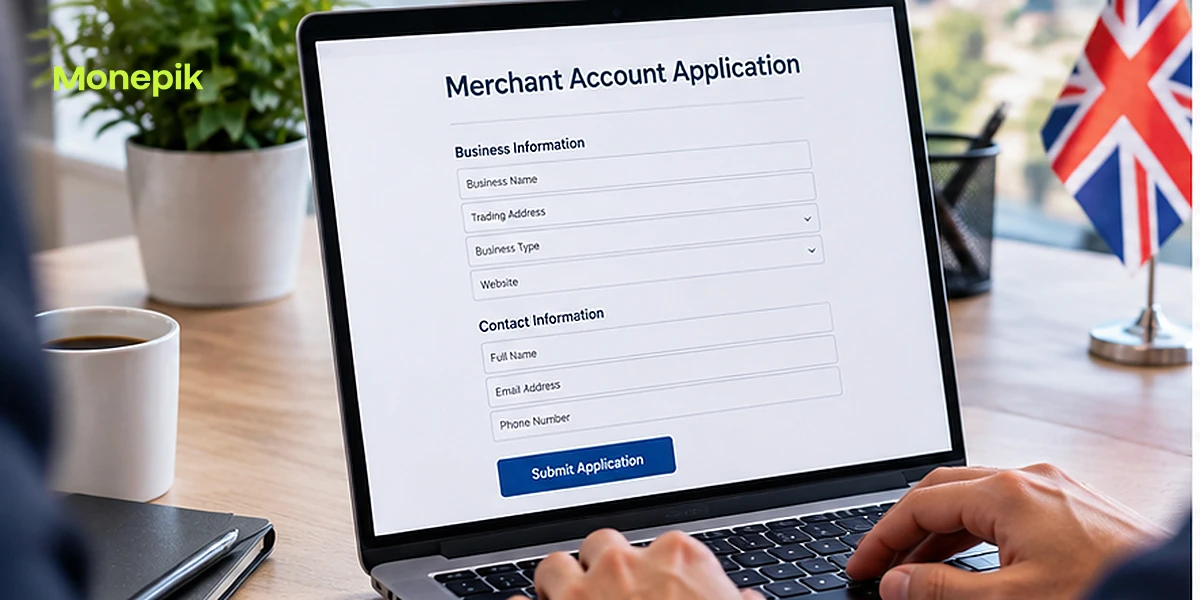
Before approving an online payment merchant account UK, the provider will normally assess both the business and the people behind it.
Because ecommerce transactions are card-not-present transactions, providers must evaluate the risk involved before allowing a business to process payments.
UK business guidance indicates that providers can request information including your website address, products or services, suppliers, fulfilment arrangements, terms and conditions, expected transaction values, projected online turnover, banking information, trading history and information about company directors or partners.
In practice, businesses should normally be prepared to provide company registration information, director or beneficial-owner identification, proof of address, business banking information, website details, refund and cancellation policies, projected monthly volumes and average transaction values.
Established companies may also be asked for previous processing statements and financial information.
The requirements may become more detailed for businesses operating in sectors with higher chargeback, regulatory or fraud exposure.
What Documents Are Needed?
Exact requirements vary between providers, but a typical UK application may require proof of company registration, identification for directors and beneficial owners, proof of residential or business address, business bank account details and information about your website.
Your provider may also review your website's terms and conditions, privacy policy, refund policy, delivery information and customer contact details.
If you already process payments, recent processing statements can also help the provider understand transaction volumes, chargeback history and payment performance.
Having these documents ready can make the underwriting process significantly smoother.
How Much Does an Internet Merchant Account Cost in the UK?
There is no standard Internet Merchant Account cost that applies to every UK business.
Pricing depends on factors such as transaction volume, average transaction value, industry, card type, customer geography, chargeback risk and the commercial structure offered by the acquiring provider.
Costs can include a transaction percentage, fixed authorisation fee, monthly account or gateway charge, chargeback fees, international card fees, currency-conversion fees and PCI-related charges.
Higher-risk businesses may also be subject to rolling reserves or longer settlement schedules.
Current provider pricing demonstrates how different these structures can be.
Provider | Current example pricing | Structure |
Worldpay eCommerce | 1.3% + 20p for Visa/Mastercard debit and credit cards on its PAYG offer | No setup or monthly fee on the referenced PAYG package |
Elavon / Opayo | From 0.99% transaction fee with £25 monthly gateway fee on its Always Open offer | Merchant account + gateway |
Barclays card Payments | Customised pricing | Rates depend on the business and transaction profile |
Stripe | 1.5% + 20p for standard UK cards | All-in-one PSP model with no standard setup or monthly Payments fee |
Worldpay's current UK ecommerce PAYG pricing states 1.3% + 20p for Visa and Mastercard debit and credit cards, while its ecommerce service includes next-business-day settlement.
Elavon's current online offer advertises a £25 monthly gateway fee, transaction pricing from 0.99%, 350 included transactions and no joining fee.
Stripe, which represents the more modern all-in-one PSP model rather than a traditional separately arranged IMA, currently charges 1.5% + 20p for standard UK cards on its standard UK pricing.
These examples show why businesses should compare the total commercial structure rather than simply choosing the lowest advertised percentage.
What Affects Your Merchant Account Pricing?
Your processing volume is one of the biggest factors.
A business processing £10,000 per month may receive very different commercial terms from one processing £2 million per month.
Card mix also matters.
UK consumer debit cards, commercial cards, international cards and premium cards can all have different underlying costs.
Your industry is another major consideration.
A standard UK retailer may have access to many acquiring options, while businesses operating in areas such as gaming, crypto, FX, subscriptions, digital products or higher-risk ecommerce may face more restricted acquiring options and different pricing.
Your chargeback history, refund levels, average transaction value, countries served and settlement requirements can also influence the final offer.
Which Internet Merchant Account Providers Operate in the UK?
UK businesses have access to a wide range of acquiring banks and payment providers.
Government business guidance identifies acquiring options including Barclaycard Business, HSBC, Lloyds Banking Group, NatWest/Royal Bank of Scotland and Ulster Bank.
There are also major specialist payment providers such as Worldpay and Elavon, alongside modern payment platforms and PSPs.
The best internet merchant account provider UK businesses should choose will therefore depend on what the merchant actually needs rather than simply which provider has the most recognisable brand.
A small domestic ecommerce shop, for example, may value simple pricing and quick onboarding.
A large international merchant may prioritise local acquiring, multi-currency settlement, sophisticated fraud controls and negotiated Interchange++ pricing.
A higher-risk merchant may need a provider specifically willing and able to underwrite its business model.
How to Choose an Ecommerce Internet Merchant Account in the UK
When comparing an ecommerce merchant account UK solution, transaction price is only part of the decision.
Start by confirming whether the provider supports your industry.
Then check which countries and currencies can be processed, which payment methods are supported and whether the provider offers domestic or cross-border acquiring where you need it.
Settlement is also important.
Ask when your funds will normally reach you and whether reserves or delayed settlement may apply.
You should also understand the complete fee schedule, including gateway fees, refund charges, chargeback costs, international-card fees and currency conversion.
Technical integration matters as well.
Check whether the provider can integrate easily with your ecommerce platform or whether you will need a custom API integration.
Finally, consider payment performance.
Approval rates, routing, fraud tools and acquiring coverage can affect how much revenue successfully reaches your business.
A cheaper processing rate is not necessarily a better deal if more legitimate transactions are declined.
How Do I Apply for an Internet Merchant Account?
The process usually starts with an application to an acquirer or payment provider.
You will provide information about your company, directors, website, products or services, expected transaction volume and countries in which you operate.
The provider then carries out KYB and KYC checks and assesses the risk associated with the business.
Once approved, you receive your merchant setup and can connect the required payment gateway or integration.
Your provider may then require testing before allowing live payments.
Simple businesses can sometimes be onboarded relatively quickly, while more complex business models may require additional underwriting.
Can Small Businesses Get an Internet Merchant Account?
Yes.
Internet merchant accounts and online payment solutions are available to small UK businesses as well as larger companies.
Some providers specifically offer simple packages designed for SMEs.
Worldpay, for example, markets its current ecommerce product to small businesses as well as larger merchants, while Elavon offers packages for different turnover ranges.
For very small businesses, an all-in-one payment provider may sometimes be simpler than negotiating a traditional acquiring arrangement separately.
As processing volume increases, however, businesses may benefit from comparing dedicated merchant accounts, custom commercial terms or multiple acquiring relationships.
Security and Compliance
Businesses accepting cards online need to take payment security seriously.
Online transactions carry additional fraud risk because the cardholder is not physically present.
PCI DSS requirements are designed to protect payment card data, while authentication measures such as 3D Secure help providers manage fraud and Strong Customer Authentication requirements.
The payment provider or gateway can reduce how much sensitive card information touches your own systems, but merchants should still understand their own responsibilities.
Fraud monitoring, chargeback management and clear refund policies should also be considered part of the overall payment setup.
Choosing the Right Payment Partner
The right UK Internet Merchant Account is not necessarily the one with the lowest headline processing fee.
The better question is whether the acquiring setup matches your business model, transaction volume, markets, risk profile and plans for growth.
For some merchants, one UK acquirer may be enough.
Others may need multiple acquiring relationships, international processing, alternative payment methods or backup payment routes.
Monepik works with a network of 350+ banks, acquirers, PSPs and EMIs, helping businesses connect with payment and banking providers based on their specific requirements.
For ecommerce merchants, that can mean looking beyond a single provider and finding payment infrastructure that supports the business as it grows.
Frequently Asked Questions
What is an internet merchant account?
An internet merchant account is a merchant acquiring arrangement designed for accepting card-not-present payments online. It enables ecommerce businesses to process customer card transactions and receive settled funds into their nominated business bank account.
How do internet merchant accounts work in the UK?
A customer's payment travels from the website through a payment gateway and acquiring infrastructure to the relevant card network and issuing bank. Once approved and settled, the merchant receives the funds according to its agreed settlement terms.
What are the requirements for an internet merchant account?
Requirements commonly include business registration details, identity information for directors or owners, bank account information, website details, products or services, expected processing volumes and appropriate customer-facing policies.
How much does an internet merchant account cost in the UK?
Costs vary considerably. Providers may charge transaction percentages, fixed transaction fees, gateway or monthly fees and additional charges for international cards, chargebacks or other services. Your industry, volume and risk profile can materially affect pricing.
What are the best internet merchant account providers in the UK?
There is no single best provider for every company. UK businesses may consider acquiring banks and payment companies including Worldpay, Elavon, Barclaycard and other specialist providers. The right choice depends on your volume, sector, customer markets and technical requirements.
How do I apply for an internet merchant account?
Choose a suitable provider, submit your company and payment-processing information and complete its KYC/KYB and underwriting process. Once approved, the merchant account and gateway can be configured and tested.
What is the difference between a merchant account and a payment gateway?
The merchant account relates to the acquiring arrangement that enables card acceptance and settlement. The payment gateway is the technology used to securely transmit payment data between the ecommerce checkout and payment infrastructure.
Can small businesses get an internet merchant account?
Yes. Many UK providers support small businesses, although the pricing model and underwriting requirements can differ depending on turnover, industry and transaction profile.
What documents are needed to open an internet merchant account?
Typical documents include company registration information, director or beneficial-owner identification, proof of address, business banking details and website information. Existing businesses may also be asked for financial information or previous payment-processing statements.
Final Thoughts
Setting up the right Internet Merchant Account UK businesses can depend on much more than finding somewhere to process a card.
Costs, acquiring coverage, settlement, fraud management, integrations and payment approval performance can all affect the final result.
As your online business grows, your payment requirements can become more complex too.
Choosing payment infrastructure that fits both your current needs and future expansion can therefore be more valuable than simply choosing the cheapest provider available today.
Looking for an online payment or acquiring setup for your business?
Monepik can connect merchants with suitable banks, acquirers, PSPs and payment providers from its global network.
Talk to Monepik about your payment requirements.
Ready to Scale Global Payments?
Build reliable payment infrastructure for global markets. Manage, expand, and optimize your payments.