Offshore Merchant Account 2026 - How It Works, Costs & Requirements
Everything you need to know about offshore merchant accounts: costs, requirements, top jurisdictions, and how high-risk businesses get approved fast.

If your business sells into multiple markets, operates in a restricted or "high-risk" vertical, or simply can't get approved by a domestic bank, an offshore merchant account is often the fastest route to reliable payment acceptance.
It lets you process card and alternative payments through a bank or acquirer based outside your home country, usually in a jurisdiction that's more open to your industry, your transaction volumes, or your corporate structure.
This guide breaks down what an offshore merchant account actually is, how offshore payment processing works in practice, what it costs, and how to choose a provider that won't leave you exposed to frozen funds or sudden terminations.
What Is an Offshore Merchant Account?
An offshore merchant account is a business bank account, held with an acquiring bank or payment service provider registered in a different country from where your company operates or is legally headquartered, that allows you to accept card payments and other transaction types from customers around the world.
Businesses typically look offshore for one of three reasons:
Their industry is classified as high risk (iGaming, crypto, forex/CFD trading, adult content, travel, pharma, CBD, and similar verticals) and local banks decline to onboard them.
They need international merchant account coverage that a single domestic bank can't provide multi-currency settlement, broader card scheme support, or acquiring relationships across several regions.
Their corporate structure is already offshore an offshore company with a merchant account is a common setup for businesses incorporated in jurisdictions like the BVI, Seychelles, or Hong Kong that need banking to match.
How Offshore Payment Processing Works

Functionally, offshore payment processing mirrors domestic processing: a customer pays, the transaction routes through a payment gateway, the acquiring bank authorizes and settles the funds, and the money lands in your merchant account (often held in USD, EUR, or GBP) before being transferred to your business bank account.
The difference is in who sits behind that flow. Instead of a single local bank, an offshore setup typically involves:
An acquiring bank or PSP licensed in an offshore-friendly jurisdiction
An offshore payment gateway to handle transaction routing, fraud screening, and currency conversion
Card scheme access (Visa, Mastercard, and often UnionPay or JCB depending on your target markets)
Support for alternative payment methods local bank transfers, e-wallets, and increasingly crypto on/off-ramps where your business needs to reach specific regions
Because offshore acquirers work with a wider risk appetite than most domestic banks, they're able to underwrite businesses that would otherwise be declined outright, provided the business can show clean transaction history, proper licensing where required, and a realistic risk profile.
Benefits of Offshore Payment Processing
Access where domestic banking says no. This is the primary driver for high-risk merchants approval where local banks won't even review the application.
Multi-currency settlement. Accept and settle in the currencies your customers actually use, rather than forcing every transaction through a single-currency account.
Higher processing limits. Offshore acquirers are often more comfortable with higher transaction volumes and average ticket sizes once a merchant is established.
Business and tax structuring flexibility. Pairing an offshore company with a merchant account can simplify cross-border operations, though this needs proper legal and tax advice specific to your home jurisdiction.
Broader payment method coverage. Offshore providers frequently support a wider mix of card schemes and local APMs, which matters if you're selling into Southeast Asia, Latin America, or the Middle East.
Redundancy. Many established merchants hold an offshore account alongside a domestic one specifically to avoid single points of failure if one processor freezes funds or terminates the relationship.
Best Countries for Offshore Merchant Accounts
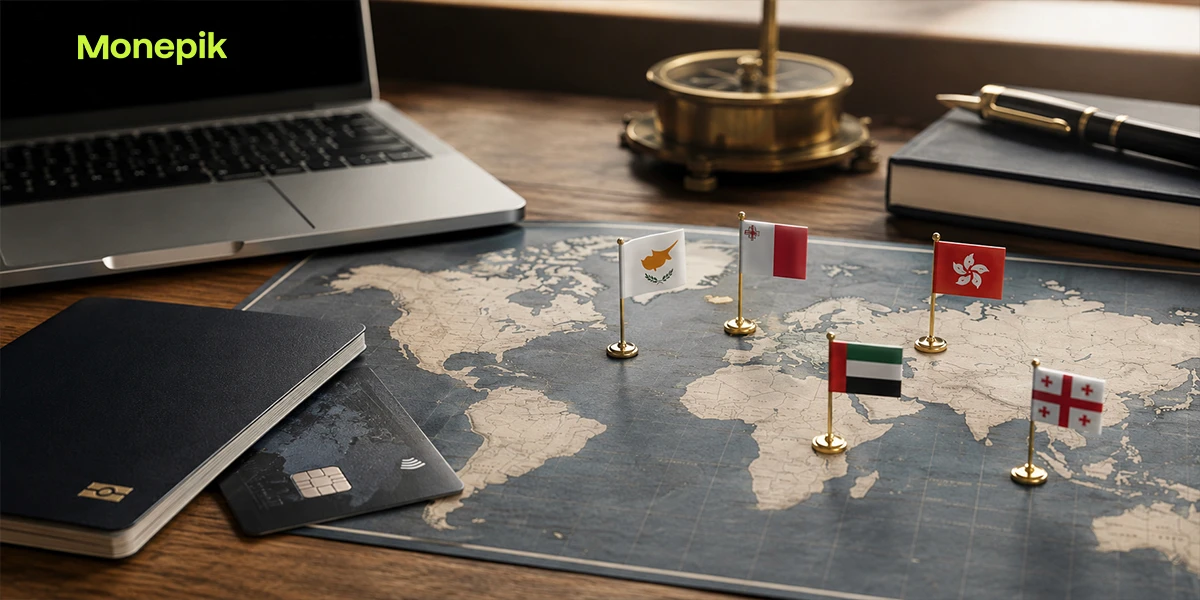
There's no single "best" jurisdiction it depends on your industry, target customer base, and corporate structure. That said, a few regions come up repeatedly:
Hong Kong — strong banking infrastructure, respected internationally, and a common base for acquirers serving Asia-Pacific merchants.
Cyprus and Malta — EU-regulated PSPs with strong card scheme relationships, popular for forex, iGaming, and fintech-adjacent businesses that want EU market access.
UAE (Dubai) — growing fast as a payments hub with increasing appetite for crypto and high-risk verticals.
Georgia — favorable for straightforward international merchant accounts with lighter regulatory friction.
Lithuania and the wider Baltics — EMI-heavy ecosystem, useful for e-commerce and fintech merchants needing IBANs and SEPA access.
Seychelles and Belize — often paired with offshore company formation, more commonly used for the corporate entity than the banking relationship itself.
The right country is really the one where your specific vertical, currency needs, and target markets line up with a bank or acquirer's actual risk appetite which is exactly why most merchants work with an introducer rather than shopping jurisdictions cold.
High-Risk Offshore Merchant Account: What's Different
A high-risk offshore merchant account exists because certain industries carry a statistically higher rate of chargebacks, fraud, or regulatory scrutiny regardless of how well-run the individual business is. iGaming, crypto exchanges, FX/CFD brokers, adult platforms, travel booking, pharma, and CBD all fall into this bucket at most acquirers.
For these businesses, the process typically involves:
Rolling reserves, a percentage of revenue held back for a set period to cover potential chargebacks
Higher processing fees relative to low-risk merchants, reflecting the acquirer's exposure
Stricter underwriting proof of licensing, source of funds, AML/KYC documentation, and a clear compliance program
A narrower shortlist of acquirers willing to take the vertical at all, which is where a specialist network matters more than a generic provider search
The tradeoff is real: high-risk accounts cost more and take longer to set up than standard accounts. But for businesses in these verticals, it's often the only path to stable, sustained payment acceptance rather than a string of short-lived accounts that get shut down every few months.

Offshore Merchant Account Costs
Pricing varies significantly by risk category, volume, and provider, but the general cost structure includes:
Cost Component | Typical Range |
Setup/application fee | $0 – $2,000+ (often waived for larger volumes) |
Transaction fee | 2.5% – 8%+ for high-risk verticals |
Monthly/account fee | $25 – $500 |
Rolling reserve (high-risk) | 5% – 20% of revenue, held 90–180 days |
Chargeback fee | $15 – $50 per incident |
Low-risk international merchant account setups sit at the lower end of these ranges; crypto, adult, and forex/CFD businesses sit toward the higher end because of the acquiring bank's own exposure. Getting an accurate quote generally requires submitting real business details website, processing history, and target markets rather than relying on published rate cards, since offshore pricing is negotiated per merchant.
Requirements for an Offshore Merchant Account
Documentation requirements are broadly consistent across providers, though high-risk verticals require more:
Certificate of incorporation and company registration documents
Proof of business address and beneficial ownership (UBO) details
Business bank statements or processing history (if available)
A functioning website with clear terms, pricing, and refund policy
Relevant licensing (gaming license, FX/CFD regulatory license, pharma license, etc., where applicable)
Founder/director ID and proof of address for KYC
Projected monthly volume and average transaction size
AML/compliance policy documentation for higher-risk categories
Missing or inconsistent documentation is the most common reason applications get delayed or declined outright which is why merchants working through a specialist consultancy tend to move faster than those applying directly and getting rejected by banks whose risk appetite was never a match to begin with.
Offshore vs Onshore Merchant Account: What's the Difference?
An onshore merchant account is held with a bank or acquirer in your own country of incorporation. An offshore merchant account is held with a bank or acquirer in a different jurisdiction, usually chosen because it's more receptive to your industry, currency needs, or volume profile.
Onshore accounts are typically simpler to open for standard, low-risk domestic businesses, and settlement is often faster within the local banking system.
Offshore accounts trade some of that simplicity for broader risk appetite, multi-currency reach, and access when domestic options are exhausted which is exactly why most offshore merchant account holders are either high-risk businesses or companies with genuinely international customer bases.
How to Choose the Best Offshore Merchant Account Provider
Vertical experience first. A provider that's placed dozens of iGaming or crypto merchants will have live acquirer relationships in that space a generalist provider may not.
Check the acquirer network, not just the provider's marketing. Ask which banks and PSPs they actually work with, and in which regions.
Understand reserve and fee terms upfront, not after you've signed and started processing.
Confirm settlement currencies and timelines match your actual cash flow needs.
Ask about redundancy. Can they place you with a backup processor if your primary account is frozen or terminated?
Look for a consultancy model over a single-processor model where possible an introducer with access to a wide network of banks and acquirers can match your business to the right fit rather than forcing you into whatever one processor offers.
This is essentially the role a payments consultancy plays: rather than a merchant approaching individual banks one by one and collecting rejections, an introducer with existing relationships across dozens of acquirers can place the business with a provider that already has appetite for that specific vertical, volume, and geography.
Frequently Asked Questions
What is an offshore merchant account?
It's a merchant account held with a bank or payment processor based in a country different from where your business is incorporated, used to accept card and alternative payments often chosen for broader risk appetite or international currency support.
How do I get an offshore merchant account?
You typically apply through a payment processor, acquiring bank, or a specialist introducer, submitting company documents, website details, and processing history. A consultancy with existing acquirer relationships can significantly speed up placement, especially for high-risk verticals.
What are the requirements for an offshore merchant account
Incorporation documents, proof of business address, UBO and director KYC, a compliant website, relevant industry licensing, and projected processing volumes are the core requirements across most providers.
How much does an offshore merchant account cost?
Costs vary by risk category: expect transaction fees from roughly 2.5% for lower-risk businesses up to 8%+ for high-risk verticals, plus monthly account fees and, for high-risk merchants, a rolling reserve.
What are the benefits of offshore payment processing?
Access to banking when domestic options decline your business, multi-currency settlement, higher processing limits, broader payment method support, and redundancy against account freezes.
What countries offer offshore merchant accounts?
Hong Kong, Cyprus, Malta, the UAE, Georgia, and the Baltic states are commonly used, alongside offshore company jurisdictions like the BVI and Seychelles, depending on the business's vertical and target markets.
What is the difference between an offshore and onshore merchant account?
An onshore account is held domestically; an offshore account is held with a bank or acquirer abroad, usually for greater risk tolerance, currency flexibility, or access where local banking isn't an option.
Can offshore merchant accounts accept international payments?
Yes; this is one of their main advantages, with support for multiple currencies and, depending on the provider, a wider range of international card schemes and local payment methods.
Can high-risk businesses get an offshore merchant account?
Yes, this is one of the primary use cases. Verticals like iGaming, crypto, forex/CFD, adult, travel, pharma, and CBD are regularly placed with offshore acquirers that specialize in high-risk underwriting.
How do I choose the best offshore merchant account provider?
Prioritize proven experience in your specific vertical, transparency on fees and reserves, confirmed settlement currencies, and ideally access to a broad network of banks and acquirers rather than a single processing relationship.
What payment methods can offshore merchant accounts support?
Most support major card schemes (Visa, Mastercard, and regionally UnionPay or JCB), along with local bank transfers, e-wallets, and, increasingly, crypto on/off-ramps depending on the provider's network.
Every business's risk profile, target markets, and volume are different, the right offshore banking setup for a crypto exchange looks nothing like the right setup for a travel platform. If you're evaluating options, it's worth speaking to a payments consultancy that can match your business against a live network of banks and acquirers rather than a single provider's rate card.
Ready to Scale Global Payments?
Build reliable payment infrastructure for global markets. Manage, expand, and optimize your payments.