What Is Payment Orchestration? And Why Does It Matter for High-Risk Businesses?
Payment orchestration is a technology layer that connects a merchant to multiple payment service providers and routes each transaction to the best available option in real time. For standard businesses, it is a performance optimisation
Quick Answer
What Is Payment Orchestration?
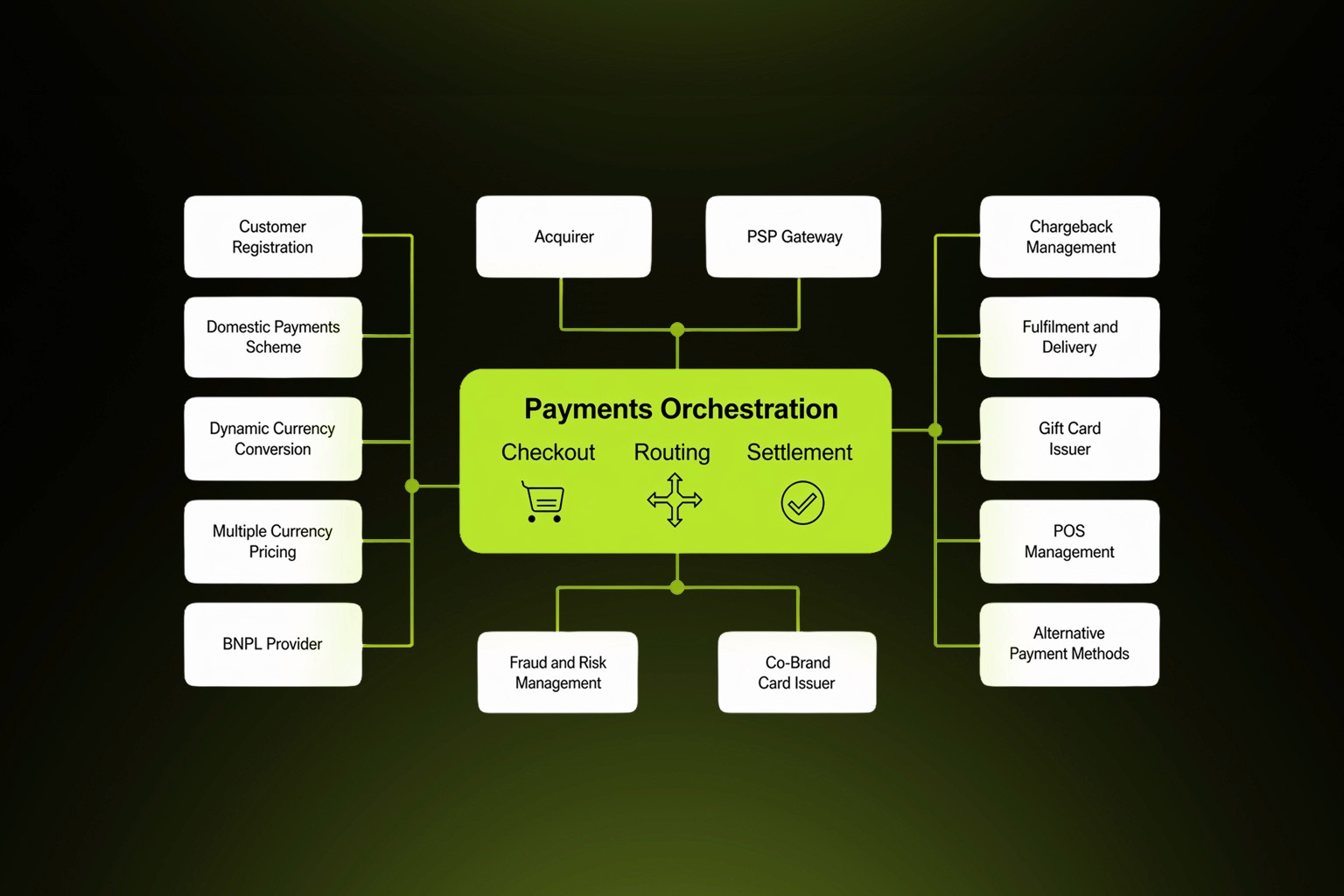
A payment orchestration platform (POP) is middleware that integrates a merchant with multiple PSPs, acquirers, and payment gateways through a single unified API. Rather than processing every transaction through one provider, the orchestration layer evaluates each payment in real time and routes it to the provider most likely to approve it based on card type, issuing bank, country, transaction amount, and continuously updated live approval data.
The most impactful mechanism is cascade routing: when a transaction is declined, the orchestration layer instantly reroutes to the next-best PSP without any customer-visible disruption. This alone consistently improves approval rates by 15% to 40% for merchants moving from single-PSP setups to orchestrated environments. Supporting components include a centralised token vault, unified cross-PSP analytics, integrated fraud scoring, 3DS2 orchestration, and multi-currency FX management all operating invisibly inside the checkout flow.
What Makes a Business High-Risk?
Payment processors classify businesses as high-risk when their profile presents elevated exposure to chargebacks, regulatory scrutiny, or reputational harm. Commonly classified industries include online gambling and iGaming, forex and cryptocurrency trading, adult content, nutraceuticals, travel booking, subscription continuity programmes, debt collection, and CBD products. A business can also be assessed as high-risk for structural reasons: operating across multiple jurisdictions, high average transaction values, or limited processing history.
Mainstream PSPs Stripe, PayPal, Square explicitly exclude most high-risk categories from their standard terms of service. This forces high-risk merchants into a smaller pool of specialist acquirers, making multi-PSP access and intelligent routing not a preference but a necessity.
The Four Problems Orchestration Solves
1. High Decline Rates
Card issuers apply stricter fraud scoring to high-risk merchant category codes (MCCs). Orchestration routes to PSPs with documented higher approval rates for that specific card type, issuing country, and MCC combination converting systemic declines into completions.
2. Chargeback Concentration Risk
Visa and Mastercard impose 1% monthly chargeback thresholds per acquirer. Exceeding them triggers fines, monitoring programmes, and account termination. Orchestration distributes volume across multiple acquirers so no single provider approaches its threshold even when overall chargeback rates are elevated.
3. Single-PSP Dependency
High-risk merchant accounts can be terminated with as little as 24 hours' notice. When all payments flow through one PSP and that relationship ends, revenue stops entirely. Multi-PSP orchestration provides automatic failover so no single provider decision can take the business offline.
4. Excessive Processing Costs
High-risk merchants typically pay 3%–8% per transaction. Orchestration routes to lower-cost acquirers where approval rates are comparable and applies 3DS only where required by regulation reducing blended processing costs by 15%–30% for most high-risk merchants.
How Monepik Delivers It
Monepik helps high-risk businesses access specialist acquirers that are more likely to support their industry, geography, and risk profile. Through our network of acquiring partners across Europe, the UK, North America, and APAC, we connect merchants with providers that offer stronger approval potential and more sustainable processing relationships.
Rather than relying on a single acquiring partner, we help businesses explore multiple options, reducing dependency on one provider and increasing payment resilience. Our experience and industry relationships enable us to identify the acquiring partners best aligned with each merchant's business model, growth plans, and operational requirements.
By simplifying access to the right acquirers, Monepik helps merchants improve approval rates, secure stable processing solutions, and support long-term growth.
Important Note: Monepik is not a payment orchestration platform. We do not provide payment routing technology, gateway infrastructure, or orchestration software. We operate as a payments consultancy and introducer, connecting merchants with specialist acquirers and payment providers through our global network.
Revenue impact: A high-risk merchant processing EUR 2M per month at 72% approval loses ~EUR 560K monthly to declines. Raising approval rates to 87% through orchestration recovers EUR 300K+ per month — often exceeding the platform cost within weeks. |
Frequently Asked Questions
Is payment orchestration only for large businesses?
No. High-risk merchants typically see positive ROI well below EUR 1M in monthly volume, because even a 5% improvement in approval rates recovers significant revenue. SaaS-based platforms make orchestration cost-effective at almost any scale.
How long does implementation take?
A standard integration with two to three PSPs takes two to six weeks. More complex builds multiple payment methods, advanced routing rules, multiple geographies typically take eight to twelve weeks. ConsultiPay manages the technical integration end to end.
What is the difference between a gateway and an orchestration platform?
A payment gateway is a single connection to one acquiring bank. A payment orchestration platform connects to multiple gateways and PSPs, routing transactions intelligently between them in real time. One lane versus the full road network.
Conclusion
For high-risk businesses, payment orchestration is not a feature it is the foundation of a resilient payment operation. It solves the four core problems that define high-risk payment processing: high decline rates, chargeback concentration, PSP dependency, and excessive cost.
Monepik is built specifically for these businesses. If your current setup relies on a single PSP, has approval rates below 85%, or has experienced account instability in the past 12 months, it is time to act. Get in Touch Today.
Ready to Scale Global Payments?
Build reliable payment infrastructure for global markets. Manage, expand, and optimize your payments.