Payment Gateway Acquirer UK in 2026: A Guide for Businesses
Understand payment gateways and merchant acquirers in the UK. Compare services, fees, settlement times and providers to choose the right payment setup.

Accepting payments online should be simple. A customer enters their card details, completes checkout, and the business receives the money.
But behind every successful card transaction is a network of payment providers working together.
Two important parts of this process are the payment gateway and the merchant acquirer.
For UK businesses, understanding how these services work can make a significant difference to payment approval rates, processing costs, settlement times, and business growth.
Whether you operate an eCommerce store, subscription platform, online marketplace, or high-risk business, choosing the right payment infrastructure matters.
This guide explains what a payment gateway acquirer in the UK does, how gateways and acquirers differ, which providers operate in the market, and how to choose the right payment setup in 2026.
Quick answer
A payment gateway is the technology that securely captures and transmits payment data from checkout. A merchant acquirer is the bank or authorised payment services provider that enables a business to accept card payments and arranges settlement. Online card payments generally need both, but they can be bought as one integrated service or as separate contracts. In the UK, acquiring is a regulated payment service under the Payment Services Regulations 2017, whereas purely technical gateway services are generally not acquiring.
What Is a Payment Gateway Acquirer in the UK?
The term payment gateway acquirer UK is commonly used when businesses search for a provider that can help them accept and process card payments.
However, a payment gateway and a payment acquirer perform different functions.
A payment gateway is the technology that securely captures and transmits payment information from a customer's checkout to the relevant payment processing systems.
A merchant acquirer, also called a payment acquirer, is the financial institution or authorised payment services provider that enables businesses to accept card transactions and arranges settlement of those payments.
Put simply:
Payment gateway: Handles the technical communication required for payment processing.
Payment acquirer: Provides merchant acquiring services and supports the movement of transaction proceeds to the merchant.
Some payment service providers offer both services through a single integrated solution, while others allow businesses to use separate gateway and acquiring providers.
In the UK, acquiring payment transactions is a regulated payment service under the Payment Services Regulations 2017. The Financial Conduct Authority (FCA) distinguishes acquiring activities from purely technical gateway services.
What Is an Acquirer in Payments?
A payment acquirer is the institution responsible for enabling a merchant to accept electronic payments through card networks such as Visa and Mastercard.
The acquiring provider works on the merchant's side of the transaction, while the issuing bank works on the customer's side.
For example, imagine a customer purchases a product worth £150 from a UK online store.
The payment gateway securely transmits the payment request. The merchant's acquirer routes the authorisation request through the appropriate card network to the customer's issuing bank.
The issuing bank checks whether the transaction can be approved.
Once the payment is authorised, the acquirer participates in the clearing and settlement process, allowing the merchant to receive the funds according to its settlement agreement.
Main responsibilities of a merchant acquirer
Enabling merchants to accept card payments
Providing access to supported card schemes
Assessing merchant risk during onboarding
Supporting authorisation, clearing, and settlement
Managing acquiring-related chargeback and fraud exposure
Applying relevant card scheme and compliance requirements
Providing settlement and transaction reporting
A merchant acquirer UK businesses work with may be a bank or a regulated non-bank payment institution. The terms acquiring bank and merchant acquirer are often used interchangeably, although not every acquirer is legally a bank.
Payment Gateway vs Acquirer UK: What Is the Difference?
Understanding the difference between a payment gateway and an acquirer is essential when selecting a UK payment provider.
Both support payment acceptance, but their responsibilities are different.
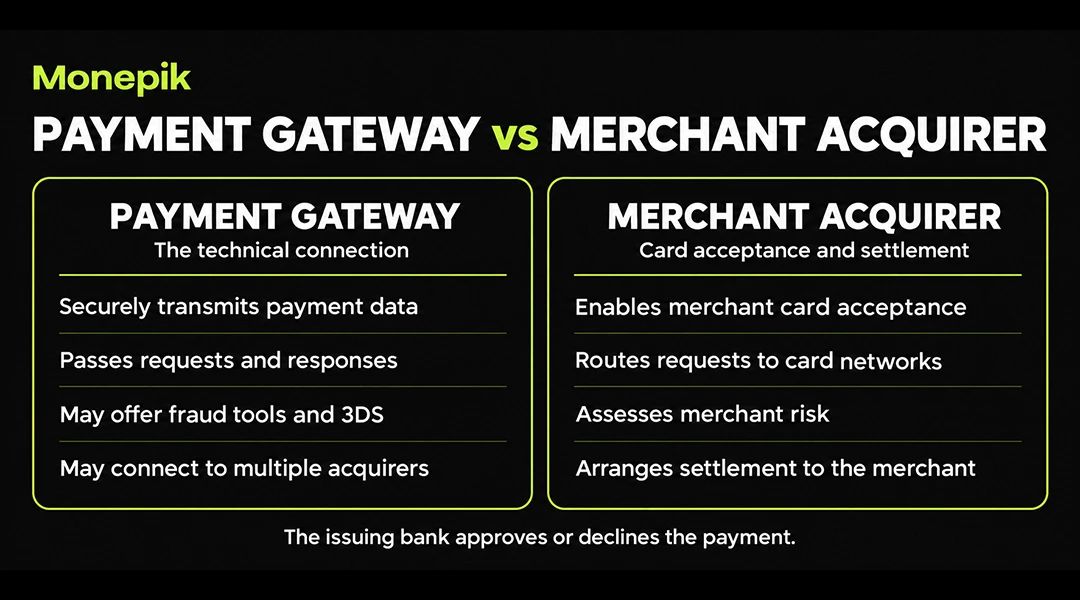
Payment gateway vs merchant acquirer at a glance
Feature | Payment Gateway | Merchant Acquirer |
|---|---|---|
Primary role | Securely communicates payment data | Enables merchant card acceptance |
Main function | Technical payment infrastructure | Acquiring and settlement services |
Handles authorisation | Transmits payment requests and responses | Routes requests through acquiring connections |
Merchant underwriting | Usually not, if gateway-only | Yes |
Settlement responsibility | Usually no, if gateway-only | Yes, under the acquiring arrangement |
Fraud tools | May provide fraud screening and 3DS integrations | Manages acquiring risk and scheme obligations |
Multiple providers | May connect to multiple acquirers | Can support multiple gateway integrations |
Regulatory position | Technical gateway-only services are generally not acquiring | Acquiring is a regulated payment service |
Example
A UK eCommerce merchant might use an independent gateway to collect payment information and an acquiring provider to process transactions.
Alternatively, the business may choose a payment service provider that combines gateway technology, processing, and acquiring services into a single commercial arrangement.
Neither structure is automatically better.
The right option depends on transaction volume, business model, payment methods, geographic markets, and risk profile.
How Does Merchant Acquiring Work in the UK?
A card payment involves several participants working together to process the transaction.[[IMG-FLOW]]
Card payment authorisation flow
Customer checks out: Enters card details or uses a supported wallet
Payment gateway: Secures and transmits the payment request
Merchant acquirer: Routes the authorisation request
Card network: Visa or Mastercard carries the request to the issuer
Issuing bank: Approves or declines the transaction
The response travels back through the payment chain. Clearing and settlement follow separately for eligible transactions.
Step 1: Customer initiates payment
The customer enters card details on the merchant's checkout page or selects a supported digital wallet.
Step 2: Payment gateway sends the transaction
The gateway securely captures the required payment information and sends an authorisation request through the connected processing infrastructure.
Step 3: Merchant acquirer processes the request
The acquiring provider sends the request through the appropriate card network and receives the response.
Step 4: Issuing bank makes the decision
The customer's issuing bank evaluates available funds or credit, fraud signals, and applicable authentication requirements before approving or declining the transaction.
Step 5: Transaction confirmation
The response is returned through the payment chain to the merchant's checkout.
Step 6: Clearing and settlement
After an approved payment is captured and submitted for clearing, the relevant financial institutions complete settlement according to the applicable arrangements.
The merchant then receives a payout based on the agreed settlement schedule, subject to fees, refunds, reserves, and other deductions.
Important: An approved transaction does not mean the money has already reached the merchant's bank account.
UK Payment Gateway Providers and Merchant Acquirers
The UK has a well-established market for gateway technology, card processing, and merchant acquiring services.
Some businesses prefer all-in-one payment solutions. Others work with separate payment gateway providers and merchant acquirers to maintain more flexibility.
Examples of companies operating in the UK payment acquiring market include:
Worldpay: Merchant acquiring and payment acceptance
Barclaycard Payments: Card acquiring and merchant payment services
Elavon: Merchant acquiring and payment solutions
Adyen: Integrated payment platform and acquiring
Stripe: Online payment acceptance and integrated payment services
Lloyds Cardnet: Merchant acquiring and card payment solutions
Global Payments: Merchant acquiring and payment technology
The UK's Payment Systems Regulator identifies a range of firms involved in the card-acquiring market, including several of these providers.
These examples are not a ranking or endorsement. Service availability, supported industries, contractual arrangements, and geographic coverage vary.
Businesses should also distinguish between the commercial brand providing a payment solution and the regulated legal entity delivering the acquiring service.
For specialist industries, a familiar brand name does not necessarily mean the provider will approve the business.
What about high-risk businesses?
Merchants in sectors such as iGaming, cryptocurrency-related services, forex, and other higher-risk industries may face additional onboarding requirements.
An acquiring provider may assess:
Business model and operating jurisdictions
Regulatory licences, where applicable
Expected monthly processing volume
Chargeback and fraud history
Customer locations and transaction currencies
Ownership structure and source of funds
Website content, policies, and customer verification procedures
This makes choosing the right acquiring partner particularly important for businesses with complex risk profiles.
What Is an Acquirer-Agnostic Payment Gateway?
An acquirer-agnostic payment gateway is a gateway that can connect merchants to multiple acquiring providers rather than relying on one acquiring relationship.
This allows businesses to maintain flexibility when choosing or switching payment acquirers.
For example, a UK merchant might use one acquirer for domestic GBP transactions and another for international card payments.
Depending on the gateway's capabilities, the business may also use routing rules to direct transactions between different providers.
[[IMG-AGN]]
Benefits of using multiple acquirers
1. Improved payment resilience
If one acquiring connection experiences technical problems, transactions may be redirected to another compatible provider.
2. Greater geographic flexibility
Different acquiring providers may offer different acceptance capabilities across countries, currencies, and card types.
3. Better cost management
Businesses can compare acquiring fees and select suitable providers for different transaction categories.
4. Reduced dependency
Relying entirely on one acquiring provider can expose a business to operational interruptions if that relationship is suspended or terminated.
However, multiple acquiring relationships do not guarantee higher approval rates. Results depend on issuer behaviour, scheme rules, routing logic, transaction characteristics, and each provider's eligibility requirements.
For growing cross-border businesses, a gateway supporting multiple acquirers can be an important part of a more resilient payment strategy.
How Much Do Payment Gateway and Acquiring Services Cost in the UK?
The cost of payment gateway and acquiring services UK businesses pay varies depending on the provider, transaction volume, industry, and payment methods.
[[IMG-FEE]]
Common charges include:
Gateway fee: Access to payment gateway technology
Acquiring fee: Merchant acquiring and processing services
Interchange fee: Fee generally paid to the card issuer
Scheme fee: Charges associated with card network services
Transaction fee: Fixed or percentage-based charge per transaction
Chargeback fee: Administrative costs associated with disputes
FX fee: Currency conversion or cross-border costs
Rolling reserve: Temporary withholding of part of settlement funds, where applicable
Blended pricing vs interchange-plus pricing
Blended pricing combines several underlying payment costs into a single advertised transaction rate, sometimes with an additional fixed fee.
Interchange-plus pricing separates interchange and other underlying costs from the acquiring provider's markup. Some arrangements itemise scheme fees as well, commonly called IC++ pricing.
For higher-volume merchants, understanding these pricing structures can help identify where costs are increasing.
The UK Payment Systems Regulator has highlighted concerns over transparency and increasing scheme and processing fees, making detailed cost comparisons particularly important.
The cheapest advertised rate is not always the most cost-effective solution. Approval rates, international fees, dispute costs, and settlement arrangements should also be considered.
How to Choose a Payment Gateway and Acquirer for a UK Business
Choosing the right payment infrastructure involves more than comparing processing fees.
A business should evaluate how well the provider supports its commercial operations, customer base, and future expansion.
[[IMG-CHO]]1. Understand your business requirements
Start by identifying your expected monthly card volume, average transaction value, operating currencies, customer locations, and payment methods. These details influence which providers are suitable.
2. Check industry acceptance
Not every acquiring provider accepts every business model. A mainstream UK retailer may have different options from a crypto-related platform, online gaming operator, or regulated financial services business. Choosing an acquiring partner familiar with your industry can reduce unnecessary onboarding delays.
3. Compare approval rates
A lower processing fee offers limited value if a significant share of legitimate customer transactions is declined. Ask providers about their support for local acquiring, authentication, decline reporting, and routing integrations.
4. Review settlement conditions
Check when funds will arrive in your business account and whether settlement is subject to reserves, minimum balances, or other restrictions. For businesses managing daily operational expenses, settlement timing can directly affect cash flow.
5. Consider multi-acquirer support
A gateway that supports several acquiring connections may offer greater operational flexibility. This is particularly relevant for businesses expanding across the UK, Europe, and other international markets.
6. Review contract terms
Examine termination rights, notice periods, pricing changes, minimum commitments, and any additional fees. Also confirm whether the gateway can remain operational if you change your acquiring provider.
7. Verify the provider's regulatory status
Check the legal entity delivering the service and its relevant UK regulatory permissions or status. Merchants should confirm who provides acquiring, who handles settlement, and which organisation is responsible for merchant risk and compliance.
How Monepik Helps UK Businesses Find the Right Acquiring Partners
Finding a suitable payment gateway or acquiring provider can be challenging, particularly when a business operates across multiple jurisdictions or works in a higher-risk industry.
At Monepik, we help businesses identify and connect with suitable payment service providers, merchant acquirers, banks, and payment technology partners.
Through our network of 350+ banking and payments partners, we support businesses seeking payment solutions aligned with their industry, geographic reach, and processing requirements.
Our services include merchant acquiring introductions, cross-border payment solutions, multi-acquirer strategies, payment gateway connections, and banking introductions.
For businesses struggling with payment declines, limited provider options, or dependency on a single acquiring relationship, we can help explore alternative payment arrangements.
Disclosure: Monepik is a payments consultancy and introducer, not a payment processor or acquiring institution. Merchant onboarding, compliance checks, transaction processing, and settlement are handled by the relevant providers. Approval and commercial terms remain subject to each provider's assessment.
Frequently Asked Questions
1. What is a payment gateway acquirer in the UK?
A payment gateway acquirer UK solution combines the technology needed to accept online payments with the merchant acquiring services required to process and settle card transactions. These services may be provided by one company or separate providers.
2. What is the difference between a payment gateway and an acquirer?
A payment gateway securely transmits transaction information, while an acquirer enables merchants to accept card payments and supports processing and settlement. A gateway provides the technical connection, and an acquirer provides the acquiring service.
3. How does merchant acquiring work in the UK?
Merchant acquiring involves an acquiring provider working with card networks and issuing banks to authorise, clear, and settle card transactions. Merchants receive payouts according to their agreed settlement terms.
4. Do UK businesses need both a payment gateway and an acquirer?
For online card payments, businesses generally need both gateway functionality and an acquiring arrangement. However, they do not necessarily need separate contracts because integrated payment providers can combine these services.
5. What is a merchant acquiring bank?
A merchant acquiring bank is a bank that provides card acceptance services to businesses. The broader term merchant acquirer also includes eligible non-bank acquiring providers.
6. Which companies provide merchant acquiring services in the UK?
Examples include Worldpay, Barclaycard Payments, Elavon, Adyen, Lloyds Cardnet, and Global Payments. Stripe also offers integrated payment acceptance services through its UK arrangements. Availability depends on the specific business.
7. What is the difference between an acquirer and a payment processor?
An acquirer provides the commercial and regulated acquiring relationship for accepting card transactions. A payment processor handles the technical processing of transaction messages and related operations. One company may perform both roles.
8. What is the difference between a payment service provider and an acquirer?
A payment service provider is a broader term covering firms that provide regulated payment services. An acquirer specifically provides payment acquiring services. Some providers also combine acquiring with gateways, reporting, and fraud management tools.
9. Can a payment gateway work with multiple acquirers?
Yes. Some gateways support multiple acquiring connections, allowing merchants to use different providers for specific currencies, geographic markets, or payment requirements.
10. What is an acquirer-agnostic payment gateway?
An acquirer-agnostic gateway allows businesses to connect to different acquiring providers without being permanently tied to one acquirer. This can provide greater flexibility for payment routing and provider changes.
11. How much do payment gateway and acquiring services cost in the UK?
Costs vary by provider, transaction volume, card type, business industry, and international payment exposure. Charges may include gateway fees, acquiring fees, interchange, scheme fees, and additional transaction-related costs.
12. What fees do merchant acquirers charge?
Merchant acquirers may charge processing fees, service fees, dispute fees, cross-border fees, currency conversion fees, and other contractual charges. Some providers combine multiple costs into a single transaction rate.
13. How long does it take to receive funds from a merchant acquirer?
Settlement timing depends on the provider and merchant agreement. Some providers offer next-business-day payouts for eligible merchants, while others settle over several business days. Higher-risk businesses may face longer settlement periods or reserve arrangements.
14. How do I choose a payment gateway and acquirer for a UK business?
Compare industry compatibility, pricing, settlement terms, supported currencies, approval performance, gateway integration, and contract flexibility. Businesses with international transaction volumes should also consider multi-acquirer capabilities.
15. Can small businesses apply directly to a merchant acquirer?
Yes. Small UK businesses can apply for acquiring services, although eligibility and documentation requirements vary. Integrated payment providers may offer a simpler application process for businesses with lower transaction volumes.
16. Can I change my acquirer without changing my payment gateway?
Yes, provided your gateway supports the new acquiring provider and the required technical integration. An acquirer-agnostic gateway can make switching easier, although merchant onboarding and configuration changes may still be required.
Final Thoughts: Building the Right Payment Infrastructure in 2026
A reliable payment setup is about more than accepting a customer's card.
It is about ensuring transactions can be authorised, processed, reconciled, and settled efficiently.
For UK businesses, understanding the difference between a payment gateway and a merchant acquirer is the starting point.
The right combination can provide better payment visibility, greater operating flexibility, and support for international expansion.
And as transaction volumes grow, relying on a single payment provider may not always be the most suitable strategy.
Need help finding a payment gateway or acquiring partner for your business?
Monepik connects merchants with payment and banking partners based on their industry, processing needs, and geographic requirements.
Explore your options with Monepik and build a payment setup that supports your business growth.
Talk to Monepik | WhatsApp | Telegram
Sources and further reading
Ready to Scale Global Payments?
Build reliable payment infrastructure for global markets. Manage, expand, and optimize your payments.