How to Get a Merchant Account with Bad Credit in 2026
Learn how to get a merchant account with bad credit in 2026. Explore approval requirements, costs, high-risk payment solutions and expert guidance from Monepik.
Getting approved for a merchant account can be difficult when you have a poor credit history. Traditional banks and payment processors often assess financial stability before allowing businesses to accept card payments.
However, bad credit does not automatically mean your business cannot get a merchant account.
In 2026, specialist acquiring providers and high-risk payment solutions may offer alternatives for businesses with low credit scores, previous financial difficulties or limited trading histories.
This guide explains how to get a merchant account with bad credit, what affects approval, what documentation you need and how to find a suitable payment provider.

What Is a Bad Credit Merchant Account?
A bad credit merchant account is a payment processing account offered to a business whose owner or company has a poor credit history.
Like a traditional merchant account, it enables businesses to accept debit and credit card transactions. However, the acquiring bank or payment processor may apply additional underwriting requirements.
Businesses may face difficulties obtaining approval because of:
Low personal or business credit scores
Previous bankruptcy or insolvency
Outstanding debts or missed repayments
Limited financial history
Previous merchant account closures
Unstable revenue or high chargeback rates
A poor credit record increases the perceived financial risk for acquiring institutions. This is because merchants remain responsible for refunds, chargebacks and other payment-related liabilities.
However, credit history is only one factor. Providers also consider the business model, industry, processing volumes and financial performance.
Can You Get a Merchant Account with Bad Credit?
Yes. Businesses with bad credit can still qualify for merchant accounts.
Some traditional acquiring banks may decline applications based on credit requirements. However, specialist merchant account providers may assess the broader financial and operational position of the business.
For example, a company with a low credit score but consistent revenue, a strong processing history and low chargebacks may still be considered for approval.
Providers typically examine:
Business revenue and financial stability
Previous payment processing history
Monthly transaction volume
Refund and chargeback ratios
Industry and geographical exposure
Ownership and compliance documentation
The important step is finding a provider whose underwriting policies match your business profile.
How Does Bad Credit Affect Merchant Account Approval?
Acquiring institutions face financial risk when processing transactions for merchants. If a business cannot cover chargebacks or refunds, the provider may become financially exposed.
Poor credit may therefore affect the conditions attached to merchant account approval.
Higher Processing Fees
Some providers may charge higher transaction fees to compensate for increased risk.
Rolling Reserves
An acquirer may temporarily retain a percentage of processed funds to cover potential future liabilities.
Lower Processing Limits
Businesses may receive initial restrictions on monthly processing volumes or individual transaction amounts.
Additional Documentation
Providers may request financial statements, bank records or explanations of previous credit issues.
Longer Approval Times
Applications requiring enhanced underwriting may take longer than standard merchant account applications.
These conditions vary between providers and are not automatically applied to every merchant with bad credit.
How to Get a Merchant Account with Bad Credit: 7 Steps
Following a structured application process can improve your chances of obtaining suitable payment processing services.
1. Review Your Credit History
Check your personal and business credit records where available.
Identify outstanding debts, missed payments or inaccuracies that could affect your application. If previous financial problems have been resolved, prepare supporting documentation.
2. Find the Right Merchant Account Provider
Not every payment processor accepts businesses with poor credit.
Search for merchant account providers for bad credit that consider applications individually and support your particular industry.
Compare provider eligibility, supported jurisdictions, processing fees, settlement arrangements and reserve requirements.
3. Prepare Your Documents
Most acquiring providers require information to verify the company, its owners and its financial activity.
Common documents include:
Certificate of incorporation
Director and beneficial-owner identification
Business bank statements
Recent payment processing statements
Financial statements or revenue forecasts
Business website and customer policies
Industry licences, where applicable
Complete and accurate documentation can reduce unnecessary underwriting delays.

4. Demonstrate Financial Stability
Even with bad credit, evidence of consistent revenue and manageable transaction risk may support your application.
Providers may review monthly sales, cash flow, refund ratios and previous processing activity.
For newer businesses, a realistic business plan and financial forecasts can provide additional context.
5. Consider a High-Risk Merchant Account
A high-risk merchant account may be appropriate when traditional acquiring providers decline your business because of its financial profile, business activities or transaction characteristics.
Specialist acquirers may have experience with industries such as iGaming, crypto-related businesses, FX/CFD and certain cross-border ecommerce operations.
However, high-risk acquiring is not a guarantee of approval. Providers still perform due diligence and assess regulatory and financial risk.
6. Compare Processing Costs and Reserves
Review the full cost of the merchant agreement before accepting an offer.
Important considerations include transaction fees, account charges, chargeback fees, rolling reserves and settlement schedules.
For example, a 10% rolling reserve on €50,000 in monthly processing volume means €5,000 would be temporarily retained under the agreed reserve terms.
Always check when and under what conditions reserved funds will be released.
7. Submit an Accurate Application
Make sure your business information, website, financial records and projected processing volumes are consistent.
Avoid submitting inflated figures or withholding details about previous merchant account closures.
A transparent application allows providers to assess your business more effectively.
Can You Get a No Credit Check Merchant Account?
Businesses with poor credit often search for a no credit check merchant account.
Some payment providers may not require a traditional personal credit bureau check. However, this does not mean they approve applications without assessing risk.
Providers may still review:
Business registration and ownership
Financial statements
Transaction history
Chargeback exposure
Industry risk
Compliance and regulatory requirements
A provider advertising no credit check may still require extensive underwriting.
No credit check does not mean guaranteed approval.
Businesses should be cautious of offers promising automatic approval without reviewing their operations.
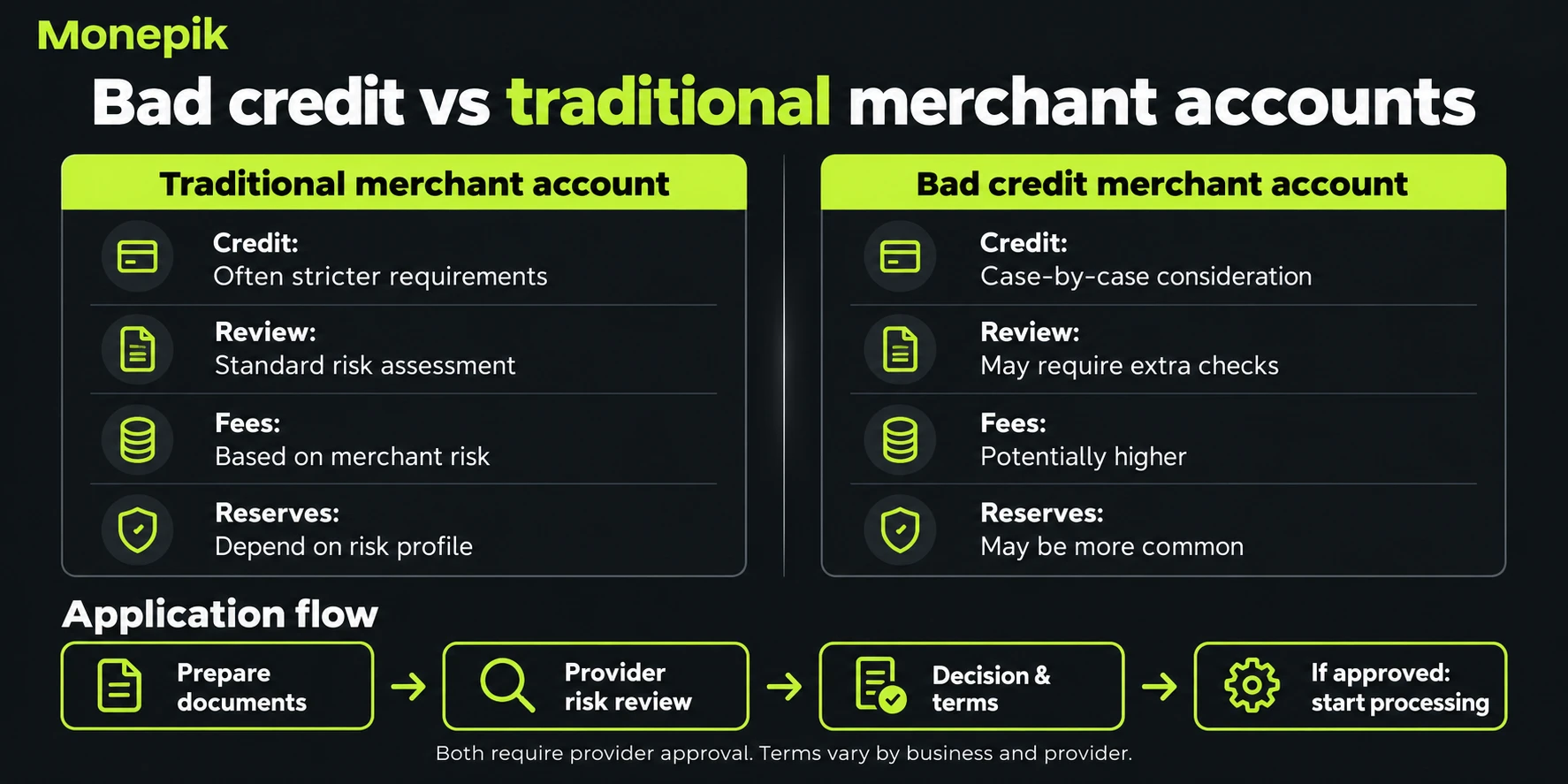
Bad Credit Merchant Account vs Traditional Merchant Account
Both account types allow businesses to accept card payments, but their underwriting and commercial conditions can differ.
Feature | Traditional Merchant Account | Bad Credit Merchant Account |
|---|---|---|
Credit requirements | Often stricter | May allow case-by-case review |
Underwriting | Standard risk assessment | May require additional checks |
Processing fees | Based on risk profile | Potentially higher |
Rolling reserves | Risk-dependent | May be more common |
Approval | Subject to provider assessment | Subject to provider assessment |
Processing limits | Based on merchant profile | May initially be restricted |
Not all specialist merchant accounts are more expensive or restrictive. Actual conditions depend on the individual business and provider.
How Much Does a Bad Credit Merchant Account Cost?
There is no universal price for merchant services for bad credit.
Acquiring providers determine pricing according to their assessment of the merchant's financial, operational and transaction risk.
Factors that influence costs include:
Industry and merchant category
Monthly processing volume
Average transaction value
Countries served
Credit and financial history
Previous chargebacks
Card types and payment methods
A business with poor credit may pay higher fees or face additional reserve requirements.
However, businesses should assess the complete commercial agreement rather than selecting a provider solely on its advertised transaction rate.
Settlement schedules, reserves and additional charges can significantly affect cash flow.

Why Do Merchant Account Applications Get Rejected?
Poor credit is not the only reason providers reject applications.
Common reasons include:
Unsupported industries: Some acquiring institutions do not serve particular business sectors.
High chargeback ratios: Excessive disputes increase potential financial exposure.
Incomplete documentation: Missing company, ownership or financial information may prevent approval.
Previous merchant account terminations: Earlier account closures may require additional investigation.
Unclear business models: Providers need to understand what the company sells and how it receives payments.
Regulatory concerns: Businesses operating in regulated sectors may require appropriate licences and compliance procedures.
Understanding the reason for rejection helps businesses identify a more suitable solution.
How Monepik Helps Businesses Find Bad Credit Merchant Account Solutions
Finding an acquiring provider can be challenging when your business has a complicated credit history or operates in a higher-risk industry.
Monepik helps businesses navigate payment processing requirements and connect with suitable acquiring partners.
As a payments consultancy and introducer, Monepik works with a network of 350+ banks, acquirers, payment service providers and electronic money institutions.
Our services include:
Merchant Account Provider Matching
We help businesses identify providers whose supported industries, jurisdictions and underwriting criteria align with their requirements.
High-Risk Merchant Account Solutions
We facilitate introductions to specialist acquiring partners experienced in complex merchant categories.
Cross-Border Payment Solutions
We help businesses explore international card acquiring and payment arrangements appropriate to their operating markets.
Multi-Acquirer Strategies
We help merchants evaluate additional acquiring relationships to reduce dependence on a single processing partner.
Application Guidance
We support businesses in understanding provider requirements and preparing for the application process.
Monepik does not directly provide merchant accounts or guarantee approval. Final onboarding, underwriting and processing decisions remain the responsibility of the acquiring or payment institution.

Frequently Asked Questions
1. What is a bad credit merchant account?
A bad credit merchant account allows a business with a weak credit history to accept card payments, subject to an acquiring provider's underwriting requirements.
2. Can I get a merchant account with bad credit?
Yes. Some specialist providers consider businesses with poor credit based on their overall financial stability, processing history and business model.
3. How does bad credit affect merchant account approval?
Poor credit can result in additional underwriting, higher fees, rolling reserves or processing limits. Approval depends on the acquiring provider's risk assessment.
4. What is the best merchant account for bad credit?
The best option depends on your industry, jurisdiction, processing volume and financial circumstances. Look for transparent pricing and appropriate underwriting requirements.
5. Do merchant account providers check personal credit?
Some providers review personal credit histories, particularly for smaller businesses. Requirements vary by provider and country.
6. Can a high-risk merchant account help businesses with bad credit?
Yes. Specialist high-risk acquirers may evaluate businesses that do not meet traditional underwriting criteria, although approval is never guaranteed.
7. What documents are needed to apply for a merchant account?
Common requirements include company registration records, identification documents, bank statements, financial records, processing statements and website information.
8. How can I improve my chances of merchant account approval?
Prepare complete documentation, provide accurate financial information, reduce chargebacks and approach providers that support your industry and risk profile.
9. Are merchant accounts for bad credit more expensive?
They can be. Providers may charge higher processing fees or require reserves depending on the risk associated with the merchant.
10. Can startups with bad credit get a merchant account?
Yes. Some providers consider startups with poor credit, although limited trading history may create additional underwriting requirements.
11. How long does merchant account approval take?
Some straightforward applications may be approved within a few business days. More complex applications may require several weeks of review.
Final Thoughts
Getting a merchant account with bad credit in 2026 is possible, but the right approach matters.
A low credit score does not automatically disqualify your business from accepting card payments. Acquiring providers also assess revenue, processing history, chargebacks, business activities and compliance.
Preparing accurate documentation and approaching suitable providers can improve your chances of securing a workable payment processing arrangement.
Looking for a merchant account with bad credit?
Monepik can help you explore payment processing options through our network of 350+ banking and payments partners.
Visit www.monepik.com to discuss your requirements and explore suitable acquiring solutions.
Ready to Scale Global Payments?
Build reliable payment infrastructure for global markets. Manage, expand, and optimize your payments.